Instrument functions
The instrument functions provide access to the description and the properties of instruments defined in the ephemeris files.
CalcephBin.getfov
- CalcephBin.getfov(instrumentid) shape, frame, vector, arraybounds
- Parameters:
instrumentid (
int) -- Instrument identifier- Returns:
FOV shape, Reference frame name, Boresight vector, Array of boundary vectors (3 components)
- Return type:
int, str, vector of 3 floats, vector of floats (3 components per vector)
This function retrieves the instrument Field Of View (FOV) description from an instrument kernel (IK) of the ephemeris file self, and computes the boundary vectors expressed in the instrument frame.
Depending on the FOV specification found in the IK, the function reads a subset of the following keywords (example names use the NAIF convention INS<id>_...):
INS#_FOV_SHAPE — shape: CIRCLE, ELLIPSE, RECTANGLE, POLYGON.
INS#_FOV_FRAME — name of the reference frame used for the boresight and boundary vectors.
INS#_BORESIGHT — the boresight vector (3 components).
INS#_FOV_CLASS_SPEC — either ANGLES or CORNERS.
If FOV_CLASS_SPEC = ANGLES additional keywords are expected:
INS#_FOV_REF_VECTOR — reference vector defining the reference axis in the boresight plane.
INS#_FOV_REF_ANGLE — half angular extent along the reference axis.
INS#_FOV_CROSS_ANGLE — half angular extent along the axis orthogonal to the reference axis.
INS#_FOV_ANGLE_UNITS — angle units (DEGREES, RADIANS).
If FOV_CLASS_SPEC = CORNERS the IK must provide explicit boundary corner vectors:
INS#_FOV_BOUNDARY_CORNERS — array of 3-component vectors giving the boundary corners.
Difference between ANGLES and CORNERS:
ANGLES: The IK describes the FOV by angular half-extents and a reference vector. Boundary vectors are computed from these values. Returned vectors share the same magnitude as the boresight.
CORNERS: The IK provides explicit boundary vectors, which are returned exactly as given. Magnitudes are preserved.
Coordinate conventions and units:
All vectors are expressed in the frame INS#_FOV_FRAME.
Angles may be in DEGREES or RADIANS; converted internally to radians.
For ANGLES, the boundary vectors preserve boresight magnitude. For CORNERS, the magnitudes are taken as-is.
For the ANGLES specification, the following formula is used internally to compute FOV boundary vectors. It describes how to rotate a vector  inside the plane defined by two vectors and
  , starting from and turning it by a given angle
  :
:

where  is the normalized projection of onto the plane orthogonal to .
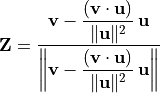
This rotation is the core operation used when computing the boundary vectors of a FOV.
For the CORNERS specification, vectors are returned as given in the IK.
The possible values for shape are :
value |
meaning |
|---|---|
1 |
Polygon |
2 |
Rectangle |
3 |
Circle |
4 |
Ellipse |
The following example prints the shape, the frame, and the boundary vector for a circular FOV
peph = CalcephBin.open("example_ik.ti")
instrumentid = -42550
[shape, frame, boresight_vector, boundary_vectors] = peph.getfov(instrumentid)
# print shape = 3
# print frame = EXAMPLE_CIRCLE
# print boresight_vector = 0    0   25
# print boundary_vectors = -3.0467         0   24.8137
peph.close()